Tủi Hổ (2025)
by Nguyễn Việt Trinh, Nguyễn Khôi
Beads, plaster, wood, candle, fire, time, performance
The title literally means ‘Shame,’ but it can also be understood as a wordplay on ‘Year of the Tiger’ in Vietnamese.
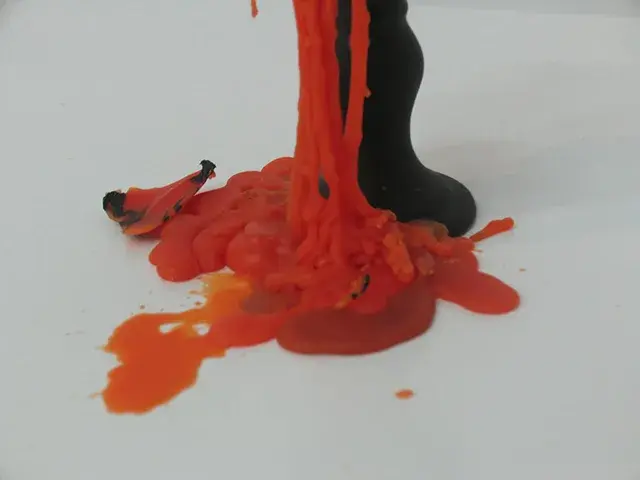
The work consists of two inverted doors, two beaded tiger-skin curtains, the reverse Phuc word in Sino-Vietnamese, an altar in the middle, two tiger-skin candles lit, and Trinh performs weaving one of the two curtains every day during the exhibition.
Women born in the year of the Tiger in Vietnamese culture are often considered to have a high fate and have difficulty getting married, to have a husband-killing fate or to dominate their husbands (Lam 2022). In addition, in Cao Dai religion, the gates of holy temples are divided into two, the right side for men and the left side for women.
Additionally, beads are chosen as the main material for the work. Beads are one of the oldest and most popular human jewelry. Beads are often associated with the Equal Rights Movement and the protests against the American war in Vietnam, as well as the disillusionment of consumer society. It is also a protest and rejection of the rigid division of gender roles and sexual control. The use of beads is often (or was) associated with beliefs related to social and cosmic order, ritual cycles related to human production and reproduction, the progression of humans through age groups, their place in the status hierarchy and above all, gender distinction. Additionally, an interesting feature of synthetic beads is that, unlike those made from materials found in nature, such as shells, stones, seeds, etc., they are often deliberately created to imitate natural stones. In that respect, they can indeed be seen as an early example of many things in contemporary life (often negative) that are considered products of the pervasive artificiality that are a matter for anthropologists to ponder: synthetics, plastics and, to turn to issues of deep current concern, artificial intelligence and artificial insemination (Sciama 1998: 1 - 46).
Furthermore, the upside-down Phuc character or Phuc dao character 福倒 is considered a traditional custom of the Chinese and also of the Chinese in Vietnam. In it, the word 倒 /dǎo/ means to pour, to reverse, to turn upside down. The pronunciation of this word is similar to 到 /dào/, which means to come. People hang the word Phuc upside down with the implication of a pun on “luck has come” (Nguyet 2024).
Chinbo Collective
Proudly designed by Nguyen Khoi
© 2025 by Chinbo Collective. Created on Wix Studio.